
Service
Dog flea and tick bath at your door
Flea and tick shampoo with any bath or groom, in our van at your home, and an honest look at what a bath can and cannot do.
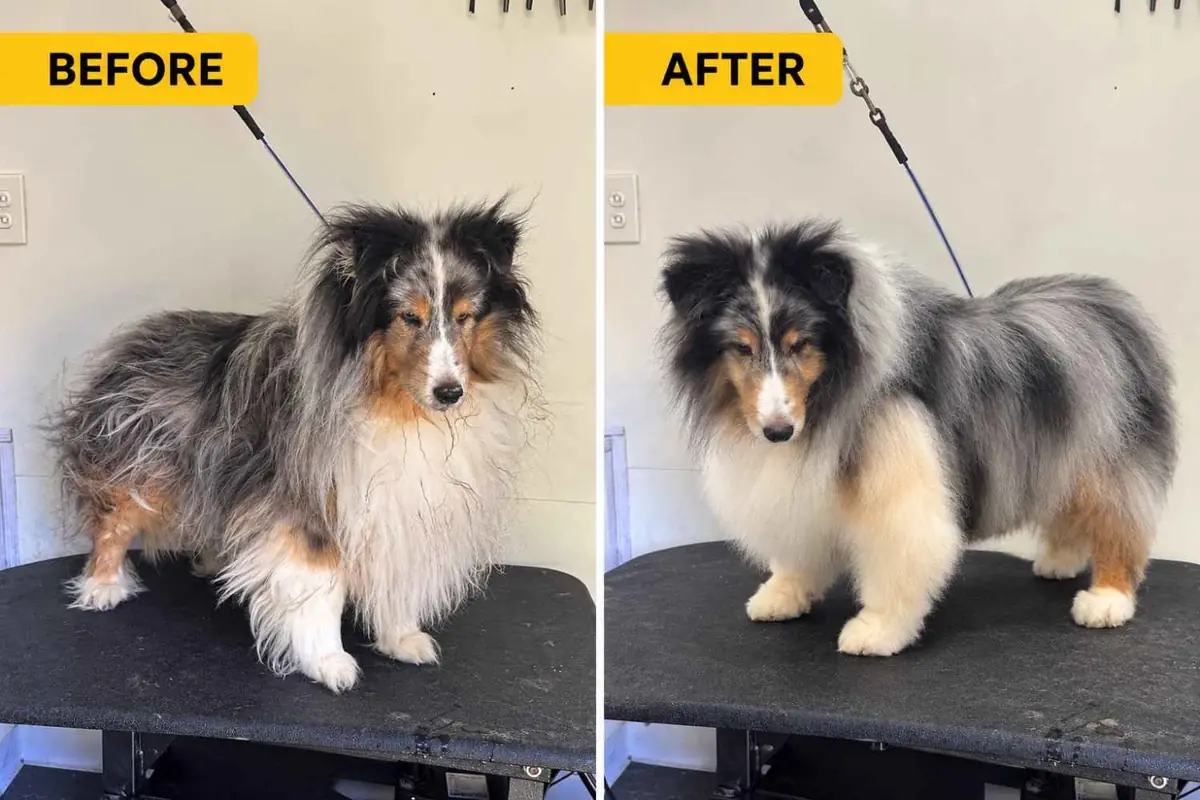
Brush Hour adds a flea and tick shampoo to any bath or groom for $20, and offers a stand-alone flea treatment application for $60. A bath removes many of the fleas on the dog that day, but most of a flea population lives in the home as eggs and larvae, so ongoing prevention from your veterinarian is still needed.
Flea and tick price
| Flea treatment application (stand-alone visit) | $60 |
| Flea and tick shampoo (add-on to a bath or groom) | +$20 |
New clients get $10 off the first visit. Your groomer confirms the final price with you before booking. See every price.
What a flea bath can and cannot do
A flea and tick shampoo removes many of the fleas on your dog that day and leaves the coat clean. It does not end an infestation, and it does not replace a preventive from your veterinarian. The reason is the flea life cycle.
According to the Merck Veterinary Manual, flea eggs fall off the dog onto bedding, carpet and soil and hatch in 1 to 6 days, and the full life cycle usually takes 3 to 8 weeks. Veterinary parasitologists estimate that up to 95% of a flea population at any time lives in the environment as eggs, larvae and pupae, out of reach of anything applied to the dog.
A controlled study makes the point with numbers: in a flea-infested setting, weekly regular shampoos never passed 79.2% flea control, while a single topical preventive treatment never dropped below 99.1% (Beugnet et al., Parasite, 2012).
So when is a flea bath worth it?
- When you find fleas and want your dog comfortable and clean right away, while the preventive starts working.
- Together with washing bedding and vacuuming, to break the cycle at home.
- When your dog is due for a bath or groom anyway. The flea and tick shampoo is a $20 add-on.
Mats can hide fleas and ticks too. A matted coat is worth handling at the same visit with dematting.
Ticks in the Bay Area
The western blacklegged tick is the most widespread of California’s 48 tick species and the one that spreads Lyme disease, according to UC Integrated Pest Management. Adults are most active from about late November to late April or early May, the rainy season. A study of San Francisco Bay Area recreation areas found Lyme bacteria in ticks at 4 of 12 sites sampled (Salkeld et al., Emerging Infectious Diseases, 2014).
The CDC advises checking pets for ticks daily, especially after time outdoors. Dogs can get Lyme disease too, with lameness, lethargy and poor appetite, and a Lyme vaccine for dogs is available in California. Ask your veterinarian whether it makes sense for your dog.
Questions dog owners ask us
Does a flea bath get rid of fleas for good?
No. Flea eggs fall off the dog onto bedding, carpet and soil and hatch in 1 to 6 days, according to the Merck Veterinary Manual. A bath removes many of the fleas on the dog that day; prevention and cleaning the home stop the cycle.
Why does my dog still have fleas after a bath?
Because most of the population is not on the dog. Veterinary parasitologists estimate up to 95% of a flea population lives in the environment as eggs, larvae and pupae, and the life cycle usually takes 3 to 8 weeks.
Do I still need flea prevention if my dog is groomed regularly?
Yes. In a controlled study, weekly regular shampoos never passed 79.2% flea control, while a single topical preventive stayed above 99.1%. Ask your veterinarian which preventive fits your dog.
Are there ticks with Lyme disease in the Bay Area?
Yes. The western blacklegged tick spreads Lyme disease in California. A study of Bay Area recreation areas found Lyme bacteria in ticks at 4 of 12 sites sampled. The CDC advises checking pets for ticks daily after time outdoors.
When is tick season in Northern California?
Adult western blacklegged ticks are most active from about late November to late April or early May, according to UC Integrated Pest Management, which is exactly the rainy season.
- Merck Veterinary Manual, Fleas of Dogs (Michael W. Dryden, DVM, PhD), updated September 2024
- Ballweber L., Flea control: does the environment really matter?, dvm360 proceedings, 2009
- Beugnet F., Fourie J., Chalvet-Monfray K., Parasite 19(2):153-158, 2012
- UC Integrated Pest Management, Pest Notes: Lyme Disease in California (Lane, Kjemtrup)
- Salkeld D.J., Cinkovich S., Nieto N.C., Tick-borne Pathogens in Northwestern California, USA, Emerging Infectious Diseases 20(3), 2014
- CDC, Preventing Ticks on Pets, May 2024